Introduction to price lists
A price list serves two equally important purposes. It contains prices for a collection of products, and defines the assortment of products available. For example, you can create a price list for a campaign, define a limited assortment for a specific group of customers, or create a VIP price list for your most loyal customers.
Video tutorial
Creating a price list
In its simplest form, a price list contains a set of products and its prices. To create a new price list, go to Pricing > Tools > New.
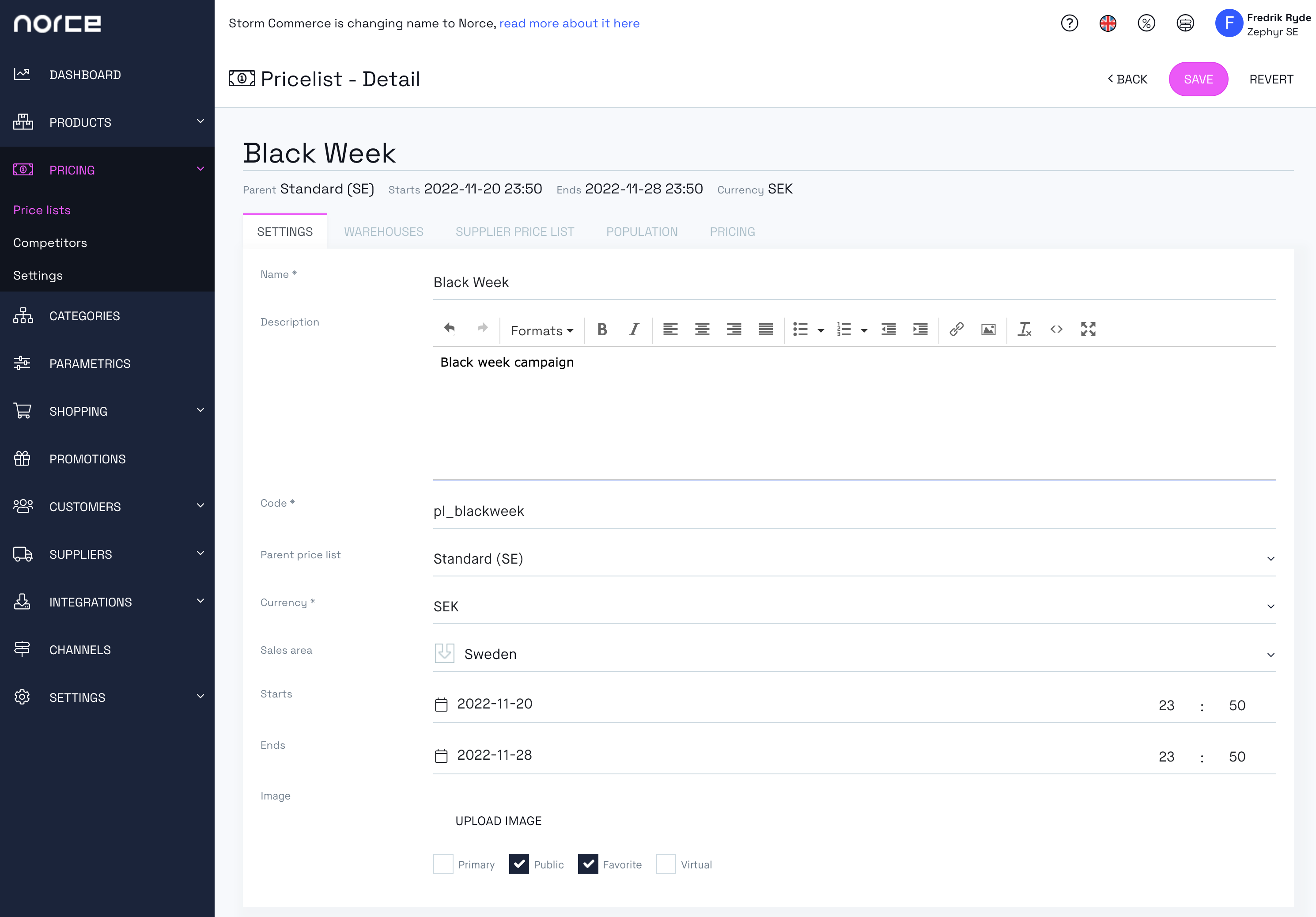
Below is a rundown of the basic settings.
| Field | Comment |
|---|---|
| Name | The name of the price list. |
| Description | A short text describing the purpose of the price list. |
| Code | Code is a unique identifier that allows integration with other systems and is necessary when importing products. |
| Parent Price List | The price list from which prices are inherited. |
| Currency | The currency of the price list. |
| Starts/Ends | The date and time when the price list is activated and deactivated. If no dates are set the price list is active at all times. |
| Price Rule | The price rule of the price list. |
| Minimum Product Margin | Default value for the minimum product margin allowed for this price list. Overrules the price rule. |
| Supplement Charge | An additional charge, fee or kickback that will be taken into the calculation of the margin. Can be both a fixed amount and a percentage. |
| Image | An image used to illustrate the price list. |
| Primary | The default price list of the application. |
| Public | Price list will be included in best price calculation. A non-public/private price list has to be explicitly included in API-calls. |
| Favorite | A favorite price list will appear as a tab in the pricing tab of the product view. Note that all public price lists will be shown as tabs. |
In order for a price list to be applied, it must be marked as Public for each application.
Disable a price list
To disable a price list, click on the "x" at the end of the price list row. The price list will then appear under "Show Inactive." Please note that you cannot deactivate the primary price list."
A price list that has not been active for at least 18 months will be deleted.
Warehouses and Suppliers
A price list can have one or more supplier price lists linked. For the Standard price list, all supplier price lists should be connected for their standard pricing.
Connected Warehouses controls product availability for the specific price list, i.e. which warehouses should be taken into consideration when On Hand availability is calculated for a product.
Common setups — where to go next
Once you understand the basics, the following guides cover common real-world scenarios:
| Scenario | Guide |
|---|---|
| Run a time-limited discount on a product selection | Setting up campaign price lists |
| Calculate prices from purchase or unit cost | Setting up cost-based (margin) price lists |
| Push prices from an ERP or external system | Setting up ERP-controlled price lists |
| Price a second market in another currency | Setting up a market price list |
| One application serving multiple markets with different VAT rates | Multi-market application pricing |
| Control which price lists apply for a B2B context | Using PriceListSeed |
| Real-time contract pricing without stored data | Virtual price lists |
| Make agreement prices take precedence over campaigns | Price list types and priority |
For a deeper explanation of how Norce selects the best price across multiple price lists, see How best-price evaluation works.